Case Study
Charivo
Modular Live2D + LLM framework for building interactive AI characters with pluggable voice and rendering layers.
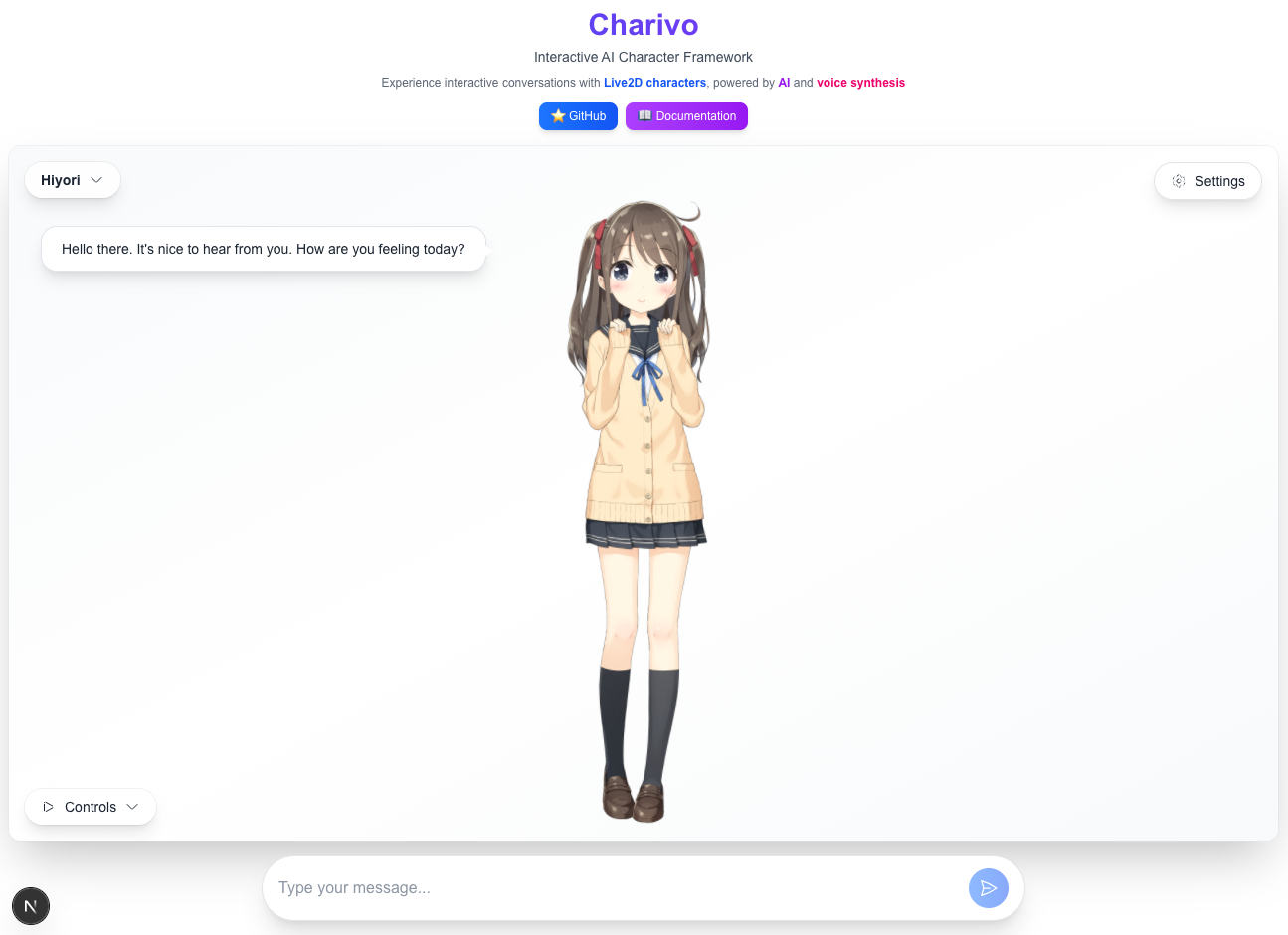
Project Overview
Charivo is a framework that abstracts the complexity of interactive character systems into composable modules. Instead of tightly coupling rendering, language, and audio, it lets developers combine components by interface contracts.
Key Features
- Modular Package System: Core, LLM, TTS, STT, Realtime, and Renderer layers are independently swappable
- Live2D Simplification: High-level APIs reduce raw SDK setup to a few integration steps
- Emotion-aware Interaction: Conversation output can map to character expressions and motions
- Voice Pipeline: Pluggable text-to-speech and speech-to-text with browser and remote providers
- Realtime Voice Support: OpenAI Realtime API support via WebRTC-focused client modules
- Framework Agnostic: Usable from React, Vue, or vanilla environments
Technical Challenges & Solutions
Challenge 1: Extensibility without chaos
Adopted manager-based architecture with clear interfaces so new providers can be added without rewriting consumers.
Challenge 2: Runtime coordination
Built event-driven orchestration to synchronize dialogue state, audio playback, and visual animation.
Challenge 3: Production-safe integrations
Separated client and server concerns to avoid exposing sensitive provider credentials in frontend contexts.
What I Learned
- Designing SDK-style TypeScript APIs for long-term maintainability
- Managing monorepo package boundaries and developer experience
- Coordinating multimodal systems (text, voice, and animation) in one framework
- Translating complex engine setup into pragmatic developer tooling
Impact
Charivo makes advanced character interaction systems accessible to application developers who need production flexibility without Live2D + LLM boilerplate overhead.